

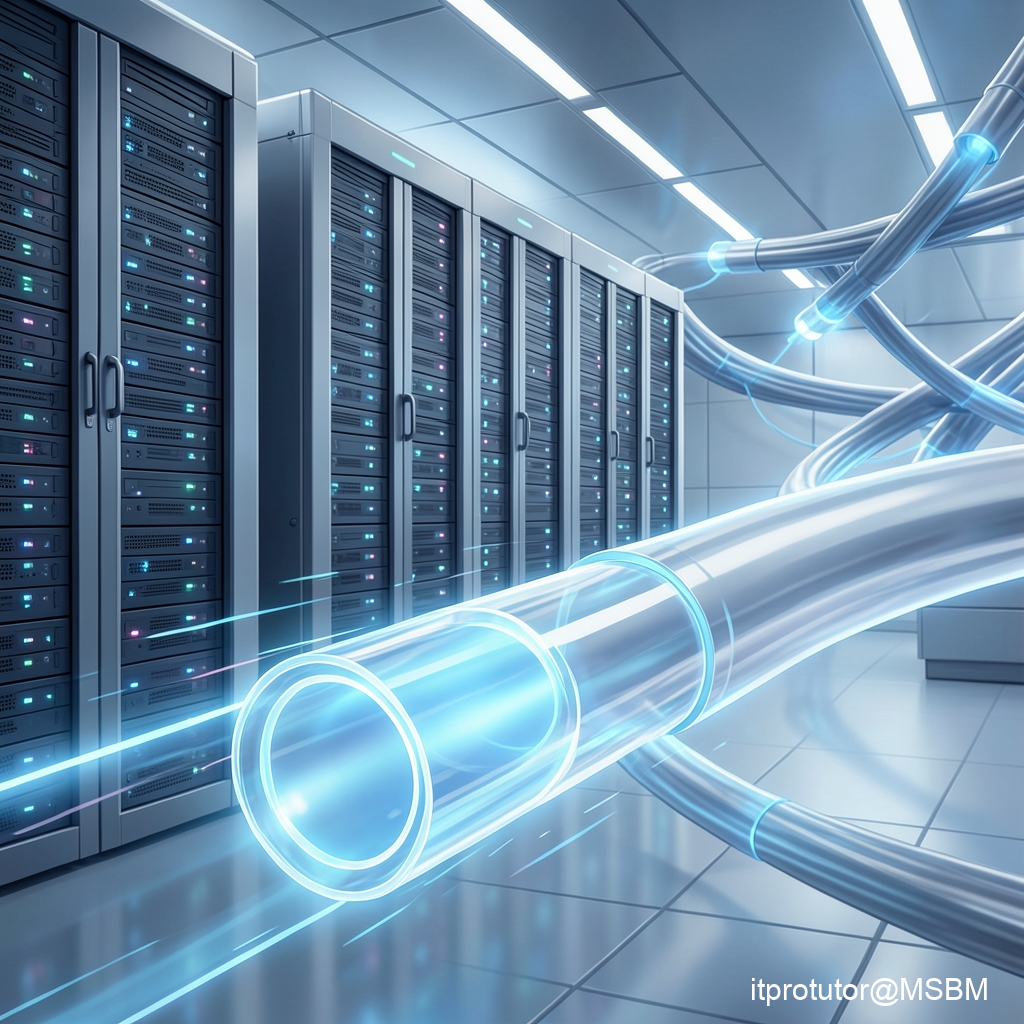
Is your data center bottleneck holding back the AI revolution? A 30% speed boost at the physical layer might just be the holy grail we’ve been waiting for.
Relativity Networks recently secured $22 million in funding to commercialize “hollow-core fiber” for data centers—a game-changing optical technology that transmits data 30% faster than traditional fiber by guiding light through air channels rather than solid glass.
From a network engineering perspective, this directly addresses the physical limits described by the refractive index principle ($n \approx 1.0$ in air vs. $1.5$ in glass). As Amdahl’s Law reminds us, system speedup is limited by its slowest bottleneck. While GPU compute power scales exponentially, inter-node latency remains a severe constraint for massive distributed workloads like LLM training.
However, we must critically evaluate the trade-offs: Hollow-core fiber has historically suffered from high manufacturing costs, splice sensitivity, and attenuation challenges. Will a 30% latency reduction justify the massive capital expenditure required to overhaul existing infrastructure? Or will this remain an exclusive competitive edge reserved for high-frequency trading and hyperscale AI clusters?
How is your infrastructure team preparing for physical-layer networking bottlenecks in the genAI era?
—
您的資料中心是否正被傳輸延遲拖垮算力?這項物理層的光纖突破,或許正是解開 AI 效能瓶頸的關鍵鑰匙!
Relativity Networks 近日宣布獲得 2,200 萬美元融資,致力於將「空心光纖」(Hollow-core fiber)導入資料中心。這項新興技術透過空氣而非傳統玻璃介質來傳輸光訊號,將資料傳輸速度大幅提升了 30%。
從網路工程的角度來看,這直接突破了光學折射率(空氣 $n \approx 1.0$ 與玻璃 $n \approx 1.5$)的物理極限。正如阿姆達爾定律(Amdahl’s Law)所提示,系統的整體效能取決於最慢的瓶頸;當 GPU 算力暴增時,節點間的網路延遲便成了分散式架構與 LLM 訓練的致命傷。
然而,我們必須批判性地思考:空心光纖過去長期面臨造價高昂、熔接困難與衰減控制等挑戰。為了這 30% 的速度提升,資料中心業者是否準備好承受昂貴的硬體替換成本?這項技術會成為高頻交易與巨型 AI 集群的專屬配備,還是未來普及的網路標準?
在生成式 AI 蓬勃發展的時代,貴團隊如何看待物理層網路升級的必要性?
#DataCenter #FiberOptics #TechInnovation #ITProTutor
Source: TechCrunch