

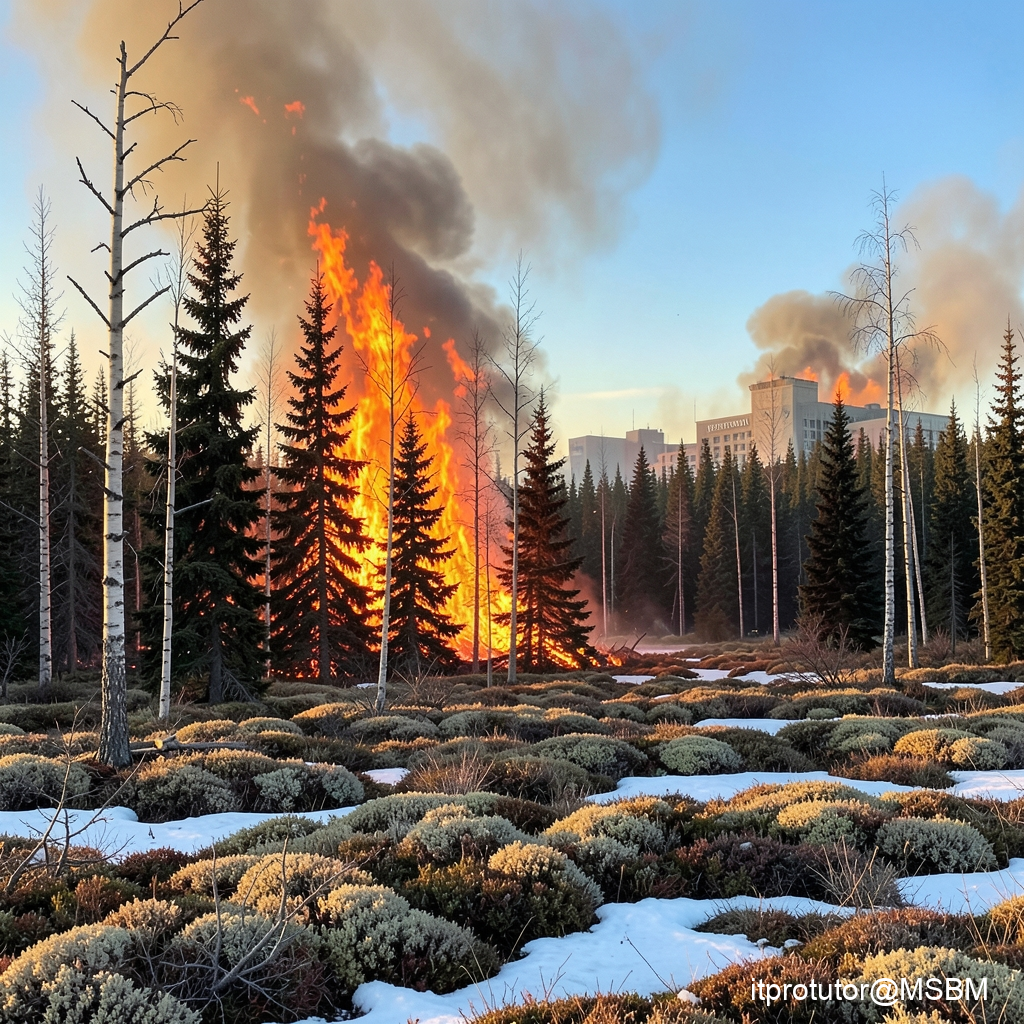
What if the most catastrophic system crash isn’t happening in a data center, but inside Earth’s natural cooling architecture? In the Arctic, escalating wildfires are obliterating the thick moss and peat that insulate permafrost—beneath which lies nearly twice the carbon currently circulating in our atmosphere. Scientists and technologists are now racing to overhaul fire management through advanced climate modeling, satellite telematics, and targeted suppression to defend these planetary carbon vaults.
From a Systems Dynamics and Chaos Theory perspective, this isn’t just an environmental hazard; it is a textbook reinforcing positive feedback loop. When fire strips the permafrost’s insulating buffer, thawing releases massive bursts of methane and CO2, accelerating global heating and triggering more fires. In enterprise IT, we build high-availability and disaster recovery (DR) protocols because the cost of data restoration far exceeds redundant monitoring. Yet in planetary engineering, we continue to treat Arctic wildfire containment as a secondary operational expense rather than mission-critical infrastructure preservation.
If we insist on strict fault tolerance and low-latency failovers for financial microservices, why do we tolerate high latency and fragmented architectures when protecting our planet’s core carbon sinks? Can AI-driven predictive modeling and automated early-response deployments scale quickly enough to outrun the compounding latency of ecological tipping points before the entire biosphere suffers an unrecoverable failure?
—
如果最致命的「系統崩潰」,不是雲端機房離線,而是地球自身的冷卻機制陷入了失控的正回饋迴路呢?近期北極野火加劇,迅速吞噬了作為天然隔熱層的苔蘚與泥炭地,直接威脅到底下封存著大氣碳總量近兩倍的永凍土層。科學家與技術人員正積極導入環境感測、衛星遙測與精準干預方案,試圖守住這座地球最關鍵的「冷凍碳庫」。
從系統動力學(System Dynamics)與 IT 容錯架構(Fault Tolerance)的角度審視,這是一場典型的增強迴路危機:大火破壞隔熱層导致凍土融化,釋放巨量溫室氣體,進一步加劇全球暖化並引發更多野火。在企業架構設計中,高可用性(HA)與災難復原(DR)是核心標準,因為事後重建的代價永遠高於即時容錯;然而在地球生態治理上,我們卻常將高緯度野火撲滅視為邊際成本,而非保護底層基礎設施的核心機制。
身為科技與架構從業者,我們習慣為數據設計極致的備援策略,但面對地球生態的單點故障風險,我們是否反應太慢?以機器學習與衛星數據驅動的早期預警系統,真能趕在環境臨界點(Tipping Point)全面失控前力挽狂瀾嗎?
#ClimateTech #Permafrost #SystemsThinking #ITProTutor
Source: MIT Technology Review